This year, SH|FT will join forces with Living Arts International to convene the Safe Havens meeting in Cambodia from 2nd – 4th December 2026, aiming to strengthen the interaction between global and southeast Asian actors in the field of the Arts in Society. Merging the strongest features from the legacies of the both well-established Meeting Point on Art & Social Action in Asia and the Safe Havens meetings in an effort to bring global and regional actors closer together and share insights and networks, we hereby present the 2026 Safe Havens meeting in Siem Reap, Cambodia.
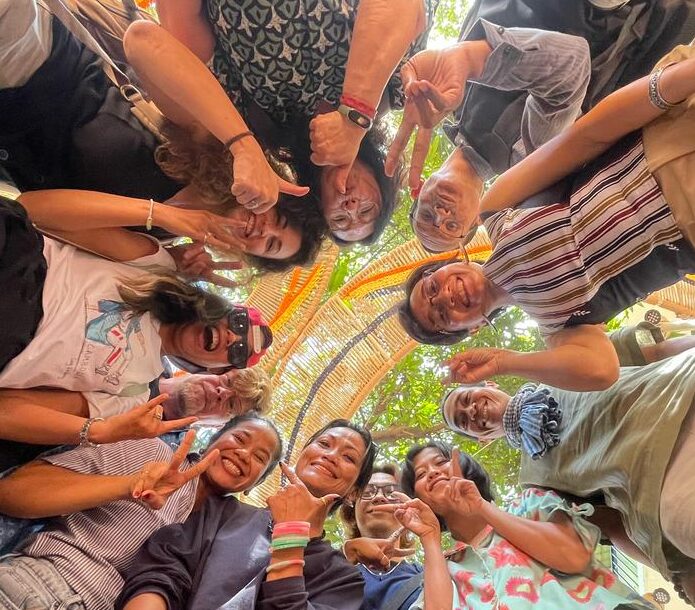
Photo: Sang Sok Serey
Spotlight on Southeast Asia
With Safe Havens 2026, SH|FT and Living Arts International want to create space for conversations that expand what we mean when we talk about artistic freedom. In joining forces, we hope to open up new pathways for strengthening artists’ ability to play a vital role in society.
Co-curated by LAI, SH|FT and RADAR, and hosted by CICADA, the program will spotlight Southeast Asia – a region that is underrepresented in cultural policy dialogues globally. Through Safe Havens 2026, we aim to create new channels of communication and connection among artists, CSOs and INGOs, to jointly work on seeing things differently. We plan to create a space that focuses on what can be done, and how those resources that exist might be deployed in new ways to build up expression and creativity, rather than dealing with crises.
Context: Narratives of cultural rights and artistic freedom
Artistic freedom gained traction as a priority issue for the international cultural sector around 15 years ago. Since then, there has been a proliferation of INGOs and CSOs documenting violations of artistic freedom, and providing support to artists, including relocating those at risk.
In large part, these have involved artists persecuted for works which transgress political or social boundaries. While this is urgent work, such cases may dominate and shape the narrative of what constitutes artistic freedom, at least on the global stage. There is a risk of blurring the boundaries between artists and human rights defenders.
This may cause us to overlook and even undermine the experiences of hundreds of thousands of arts and cultural practitioners who may not position themselves on the front lines of political opposition, but whose artistic freedom is nonetheless hampered for a myriad of reasons.
Taking Part
Our aim is to increase understanding of the Southeast Asian context by global actors, and to expand awareness of global support systems in the field of artistic freedom among actors in Asia.
Registration for participation in the meeting will be opened in September 2026.
In late April we will be releasing an open call for practitioners and organisations from Asia to run workshops related to Asian perspectives on artistic freedom.
If you have knowledge or resources that you consider relevant to the meeting objectives and would like to contribute, please contact post@sh-ft.org for further discussion.
The organisers
Safe Havens Freedom Talks (SH|FT) is a Swedish non-profit organisation dedicated to the protection and promotion of artists at risk and artistic freedom. SH|FT provides open platforms for human rights defenders in the arts globally.
Living Arts International (LAI) promotes culture and the arts as a powerful force for a compassionate 21st century world. Spurred by its roots in Southeast Asia, where it works as Cambodian Living Arts and Mekong Cultural Hub, it champions cultural initiatives that catalyse dialogue, connecting and grounding us in our humanity across borders.
Programming partner
RADAR cultivates and supports the Southeast Asian arts ecosystem by creating platforms for discourse about the art making environment. Through research projects, it supports the cultural rights of its principal stakeholders – arts critics, arts makers and arts audiences. It actively fosters inter-regional links between Southeast Asia and the rest of the world.
Cambodia Project Lead
The Creative Industries of Cambodia Association for Development and Advocacy (CICADA) was co-founded in 2020 by six leaders from the cultural sector. Now a national association representing 152 members, through civic education, data-driven advocacy, and policy dialogue, CICADA empowers cultural and creative workers to exercise their democratic rights in shaping policies that affect their livelihoods and Cambodia’s broader socio-economic and environmental development.
The 2026 meeting is supported by the Swedish Arts Council Artistic Freedom Programme, the Ministry of Culture, Taiwan, and On the Move*.
*Funded by the European Union. Views and opinions expressed are however those of the author(s) only and do not necessarily reflect those of the European Union or the European Education and Culture Executive Agency (EACEA). Neither the European Union nor EACEA can be held responsible for them.